Friday, April 1, 2011

April is Child Abuse Protection Month

Bishop Blase Cupich (the rector of the Pontifical College Josephinum when I was a seminarian) recently wrote an article called: "12 Things Bishops Have Learned from the Clergy Sexual Abuse Crisis."  It follows:
The Catholic bishops of the United States have learned many lessons from the sex abuse crisis. These twelve are among the most important. 

1. The injury to victims is deeper than non-victims can imagine. Sexual abuse of minors is crushing precisely because it comes at a stage in their lives when they are vulnerable, tender with enthusiasm, hopeful for the future and eager for friendships based on trust and loyalty.

2. Despite the justified anger felt by victims toward the church, bishops still need to reach out to them as pastors. Meetings with victims can be challenging for all involved, but they also can be a moment of grace and insight.

3. The causes of the clerical sexual abuse are complex, and it is simplistic to reduce them to easy answers. Many factors have been alleged to “explain” this misconduct by clergy, but the fact is that sexual abuse of minors is found in many different circumstances, perpetrated by family members, leaders of youth organizations, doctors, teachers and others. “Easy answers” underestimate how wide the scope of this problem is in our society.

4. Catholics have been hurt by the moral failings of some priests, but they have been hurt and angered even more by bishops who failed to put children first. People expect religious leaders above all to be immediate and forthright in taking a strong stand in the face of evil, such as the harm done to children and young people by sexual abuse.

5. The counsel of lay people, especially parents, is indispensable in a matter that so deeply affects families. Our capacity to respond to sexual abuse of young people has been bolstered by the insights shared with us by parents as to how to do so effectively.

6. Our priests have a resiliency that future generations will recall with admiration. They have remained committed to their vocation day-in, day-out, despite suffering from the actions of those who have besmirched the priesthood they love. Their steadfastness has built a reservoir of good will with our people and is a major factor in explaining why during this terrible crisis most Catholics in our country remain faithful to the church.

7. The church needs to maintain the mandatory safe environment efforts that have been developed. Experience shows that institutions are not as effective in protecting children if standards are voluntary. Any backsliding on this endangers children first of all, and also the credibility gained through the efforts to eradicate the effects of this scourge. Parishes must be the safest places for a child to be.

8. Bishops need to be mutually accountable in their efforts to protect children and must be willing to participate in transparent, independent audits to demonstrate they are keeping the promises we made. What happens in one place happens to us all.

9. Bishops need to resist the defensiveness that institutions often fall back on in crisis moments. Resorting to a conspiratorial interpretation of attacks and adopting a “circle the wagons” approach only prolongs a problem and does nothing to settle it or heal the victims.

10. Self deception is an inherent part of the illness abusers suffer and includes the inclination to diminish the gravity of their behavior and its effects on the individuals abused and on the church at large. Many even manage to convince themselves that they genuinely cared for the children whom they harmed. This makes it almost impossible for them to come to grips with the evil they perpetrated. Claims often made by perpetrators in the past that they were contrite and would stop abusing are never again going to be taken at face value.

11. Our people’s faith is strong and sustains them even in times of challenge. We receive from them a level of emotional and spiritual support which humbles us. Their trust in God sustains not just themselves but us too.

12. Bishops must partner with public authorities by complying with civil laws with respect to reporting allegations of sexual abuse of minors and cooperating with their investigation. All leaders of the community whether religious or secular need to work together to protect children and young people.
 
The Charter for the Protection of Children and Young People, which we bishops adopted in 2002 and renewed twice since, provides direction for our handling the sexual abuse of minors by priests. It can be found on the Web site of the U.S. Conference of Catholic Bishops: http://www.usccb.org/ocyp/charter.shtml

Wednesday, March 30, 2011

Memories of John Paul II

As Pope John Paul II's beatification draws close (May 1 - the "liturgical" anniversary of his death - the feast of Divine Mercy) - memories of His Holiness begin to be recalled.  Here are some very close-up memories from the papal photographer.


Tuesday, March 29, 2011

Converting our Hearts Every Day

The following is taken from "CatholicCulture.org."

The Season of Lent for every Christian should mark a turning point, accentuating that change in thought and life which becomes daily in those who truly wish to follow Jesus. In the Gospel the word “daily” is heard many times, for example speaking of the demands of discipleship, the Lord says: “every day” it is necessary to take up the cross and follow Him (cfr. Lk 9, 23). “ Every day ” is synonymous with “totality,” donation, which, because it is “daily”, renews itself and never breaks up, never weakens. Just as running water flows continually and is always fresh and clear, so too the spiritual life: to maintain its vivacity it draws continually from the grace which flows from Jesus. In this sense we clearly understand the necessity to “pray without ceasing”.

A great temptation on the path of conversion is to stop, to “stagnate”: we remain as we are, we do not to renew ourselves, and in doing so deceiving ourselves and others with a “Christianity” consisting of habits and “goals reached”. The journey of Lent invites us to remove these illusions, the word of Jesus resounds louder than ever: “repent and believe in the Gospel”. To be authentic conversion should never stop; the true Christian experiences the dynamics of conversion, like walking behind Jesus, on a path which never stops because it is at the spiritual level, if we stop, we go backwards! “ 'Once the hand is laid on the plough, no one who looks back is fit for the kingdom of God.'” (Lk 9, 62).

So as not to interrupt our conversion, our journey of 'becoming' Christians, the only possibility is daily conversion: denying ourselves, our ambitions every day, with the dynamic power of love. Selfishness has its own dynamics, which is also daily and drives us to satisfy 'ego'. Only the disciple who gives himself entirely to the Lord, day after day, becomes increasingly similar to his Master and lives in joy, light and love.

If a Christian says he has no joy, light or love then he must make a profound examination of conscience to discern areas where the power of selfishness prevails over the dynamics of conversion.

It is not God who is sparing with himself, or who hesitates to give Himself to us, it is man, as St Teresa of Avila says so well: “ If we attain to the perfect possession of this true love of God, it brings all blessings with it. But so niggardly and so slow are we in giving ourselves wholly to God that we do not prepare ourselves as we should to receive that precious thing which it is His Majesty's will that we should enjoy only at a great price.” (Life, chapter 11, paragraph 1).

Dying to self costs, but it obtains the greatest result: it allows Jesus to live in us. In fact there can be no dynamics of conversion, without daily “renouncing self" precisely to live for Jesus. The Word of God says clearly that only those who lose themselves, who give themselves entirely to God, truly find Him and enjoy Him here on earth: “ If, however, from there you start searching once more for Yahweh your God, and if you search for him honestly and sincerely, you will find him.” (Deut 4, 29). The Lenten journey is therefore a path of self-giving and trusting in God which culminates at Easter with new birth in Jesus. The Holy Father, Pope Benedict XVI, describes this dynamics with the following illuminating words: “Jesus' invitation to take up one's cross and follow him may at first sight seem harsh and contrary to what we hope for, mortifying our desire for personal fulfilment. At a closer look, however, we discover that it is not like this: the witness of the saints shows that in the Cross of Christ, in the love that is given, in renouncing the possession of oneself, one finds that deep serenity which is the source of generous dedication to our brethren, especially to the poor and the needy, and this also gives us joy. The Lenten journey of conversion on which we are setting out today together with the entire Church thus becomes a favourable opportunity, "the acceptable time" (II Cor 6: 2) for renewing our filial abandonment in the hands of God and for putting into practice what Jesus continues to repeat to us: "If any man would come after me, let him deny himself and take up his cross and follow me" (Mk 8: 34) and this is how one ventures forth on the path of love and true happiness. (…) let us ask Our Lady, Mother of God and of the Church, to accompany us on our way through Lent, so that it may be a journey of true conversion. May we let ourselves be led by her, and inwardly renewed we will arrive at the celebration of the great mystery of Christ's Pasch, the supreme revelation of God's merciful love.” (Benedict XVI, General Audience 6 February 2008). 

Msgr. Luciano Alimandi (Agenzia Fides 20/2/2008; righe 54, parole 792)

Saturday, March 26, 2011

The Scrutinies

This weekend the Elect (those members of the RCIA who are preparing to be Baptized, Confirmed and receive the Eucharist at the Easter Vigil) will celebrate the First of three Scrutinies.  What are these Scrutinies about?

Well, these very special rites are celebrated on the last three Sundays of Lent, at liturgies where the Elect are present - for our parish this is during the 10:45am Mass.  Part of their journey to the font that we have already witnessed is the Rite of Welcome (which we celebrated in November), and then they enrolled their names in the Book of the Elect before being sent to Bishop McFadden in Harrisburg on the First Sunday of Lent for the Rite of Election.  

Even if these rites are not celebrated at the liturgy we attend it can be wonderful to reflect upon the journey these Elect are making during Lent, as an inspiration and source of renewal for us in our journey.

These are ancient rites and they may, at first, seem strange to us.  But they are profoundly rooted in our human experience.  We need to examine (scrutinize) how we are, the areas of our lives where we are tempted, or seriously sin - in what we do and what we fail to do.  We really need healing and the strength that can come from the support of our sisters and brothers.

The Rite goes like this:

First there is the Invitation to Silent Prayer.  One of the most powerful moments of the Scrutinies is how they begin.  After the homily, the Elect are invited to come forward with their sponsors and to kneel down.  Then, the whole assembly is invited to pray for them in silence.  It is a very solemn moment.  This community has cared for these elect for some months now on their journey.  We have sent them to reflect more and more deeply on the Word of God, and expressed to them our longing for the day on which they would join us at the table of the Lord.  Now we pray for them in this sacred silence, deeply asking God to protect them and heal them in the weeks ahead.

Then there are the Intercessions for the Elect when we, as a community, pray aloud for the Elect.  What follows is technically called the Prayer of Exorcism - we pray that they might be freed from the power of the Evil One and protected on their journey.  But don't worry - no "Linda Blair" moments...

The Laying On of Hands follows: an ancient, silent ritual deliberately reminiscent of the rite used for ordination in the Sacrament of Holy Orders, the priest or deacon lays his hands for a brief moment on the head of each of the Elect.  It is a solemn act of calling down the Spirit of Jesus to be with them and protect them.

Lastly the Elect are dismissed from the assembly and sent forth to reflect upon the Word and this powerful gesture of love on the part of this community, that cares for them so deeply, with the love of Christ.  (This we have been seeing all year long)

This year we have 7 members of the Elect here in our parish - which will make for a WONDERFUL celebration of the Easter Vigil on April 23.

Friday, March 25, 2011

Joanne Marie Schoonover Mass - 10am Saturday

Joanne Marie (Maixner) Schoonover, 76, a longtime resident of Waynesboro, died on the first day of spring, Sunday, March 20, 2011, with her family by her side. She passed away peacefully amid the chirping of birds as they welcomed the first crocus blooms of the season.

Born in New York in 1934 to Frederick and Julia Maixner, she attended Our Lady of Lourdes Roman Catholic School and Dominican Commercial High School, both in Queens, N.Y. She held many interesting positions with General Motors, AT&T, New York Telephone and United Airlines.

In 1958 she married Stanley C. Schoonover. They lived in Chester, Vt., before moving to Waynesboro in 1967. Together they raised eight children and enjoyed traveling throughout the United States and abroad. For more than 30 years she ran the family endeavor of delivering The Record Herald along a route in the Eastland Hills area of Waynesboro.

She was an accomplished expert in the textile crafts. Mrs. Schoonover taught quilting locally and demonstrated crafts as a volunteer for the National Park Service at Catoctin Mountain Park, in Thurmont, Md. As one of the founders of the Buchanan Trail Quilt Club, she taught textile crafts to senior citizens through the Hagerstown Junior College. Her enthusiastic approach to craftwork was unmatched. She always had time for those desiring to learn and her unselfish teaching and outreach brought much joy to many. In her later years she enjoyed piecing many quilts which were finished by her daughter, AnnMarie Cowley.

An accomplished gardener, she is remembered for the flowery front lawn at her East Main Street home. She shared this love with anyone willing to stop and talk. She also had a passion for cooking. Through her culinary skills, she brought a variety of food experiences to her family. With such a breadth of cooking expertise, it was often said that family meals were rarely prepared the same. Joanne always had room for one more at every table she set.

She kept a home filled with love and great joy and relished being surrounded by her large family. Through an impressive Lego collection she fostered creativity and imagination in her grandchildren and many other children from the community. She was a member of St. Andrew’s Roman Catholic Church. She is preceded in death by her parents and an infant brother, Harry.
 
In addition to her husband of more than 50 years, she is survived by eight married children, AnnMarie (Kevin) Cowley, Hillsboro, Ore., Donna (Larry) VanWert, Springfield, Va., William (Andrea) Schoonover, Deale, Md., Johnathan (Vivian) Schoonover, Radcliff, Ky., Stephen (Laura) Schoonover, Waynesboro, Pa., Christine (John) Sanbower, Chambersburg, Pa., Irene (Brian) Slater, Lindley, N.Y., and Frances (Paul) Shehadi, Wallingford, Pa., along with 23 grandchildren and nine great-grandchildren. She is also survived by two brothers, Frederick (Louise) Maixner, Spring Garden, Fla., and Raymond Maixner, Houston, Texas.

A memorial Mass will be held at 10 a.m. Saturday, March 26, at St. Andrew’s RC Church, Waynesboro, Pa., with a reception following. In addition, friends may visit with the family from 3 to 4 p.m. Saturday at the parish hall. In lieu of flowers, donations can be made to the Waynesboro Area Gala Cancer Auction, P.O. Box 244, Waynesboro, Pa. 17268.

Thursday, March 24, 2011

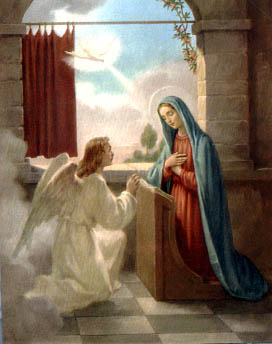
Solemnity of the Annunciation - Feast, no Fast!

The Feast of the Annunciation, March 25, is one of the most important in the Church calendar. It celebrates the actual Incarnation of Our Savior the Word made flesh in the womb of His mother, Mary.
 
The biblical account of the Annunciation is in the first chapter of the Gospel of Saint Luke, 26-56. Saint Luke describes the annunciation given by the angel Gabriel to Mary that she was to become the mother of the Incarnation of God.

Here is recorded the "angelic salutation" of Gabriel to Mary, 'Hail, full of grace, the Lord is with thee" (Ave, gratia plena, Dominus tecum - Lk 1:28), and Mary's response to God's will, "Let it be done to me according to thy word" (fiat mihi secundum verbum tuum) (v. 38)

This "angelic salutation" is the origin of the "Hail Mary" prayer of the Rosary and the Angelus (the second part of the prayer comes from the words of salutation of Elizabeth to Mary at the Visitation).

The Angelus, a devotion that daily commemmorates the Annunciation, consists of three Hail Marys separated by short versicles. It is said three times a day -- morning, noon and evening -- traditionally at the sound of a bell. Here at Saint Andrew's our parish bell plays the Angelus 4 times a day: 8am, noon, 6pm & 9pm.  We begin every daily Mass praying the Angelus as the bell rings.  The Angelus derives its name from the first word of the versicles, Angelus Domini nuntiavit Mariae (The Angel of the Lord declared unto Mary).

Mary's exultant hymn, the Magnificat, found in Luke 1:46-55, has been part of the Church's Liturgy of the Hours, at Vespers (evening prayer), and has been repeated nightly in churches, convents and monasteries for more than a thousand years.

The Church's celebration of the Annunciation is believed to date to the early 5th century, possibly originating at about the time of the Council of Ephesus (c 431). Earlier names for the Feast were Festum Incarnationis, and Conceptio Christi, and in the Eastern Churches, the Annunciation is a feast of Christ, but in the Latin Church it is a feast of Mary. The Annunciation has always been celebrated on March 25, exactly nine months before Christmas Day.

Two other feasts honoring Our Lord's mother, the Assumption (August 15), and the Immaculate Conception (December 8), are celebrated as Holy Days of Obligation in the United States and many other countries. New Year's Day, January 1, is observed as a Solemnity of Mary. The Annunciation was a Holy Day throughout the Universal Church until the early 20th century. Many Catholics who are deeply concerned with the defense of the life of unborn children believe it would be fitting if the Feast of the Annunciation were restored to this status. Although it seems unlikely that it will be added to the Church calendar as a Holy Day of Obligation, we can certainly take on the "obligation" ourselves to attend Mass. In any case, it is most appropriate that we encourage special celebrations in the "Domestic Church".

One sign of the significance this Christian feast had throughout Western culture is that New Year's Day was for centuries celebrated on March 25. It was believed by some ancient Christian writers that God created the world on March 25, and that the fall of Adam and the Crucifixion also took place March 25. The secular calendar was changed to begin the year on January 1 (in 1752 in England and colonies, somewhat earlier on the continent).

Another remnant of the historic universality of Christianity in the West is the use of BC (before Christ) and AD (Anno Domini The Year of Our Lord) to denote periods of time in history. There has been an attempt in some circles to change BC to BCE (before the common era), and AD to CE (common era) -- and although it is true that the religious significance of our system of dating has been effectively obliterated -- nevertheless, Christians and non-Christians alike consent to the birth of Christ as the "fulcrum" of the dating the events of human history. 

Oh, and this year, because the Solemnity is on a Friday - EAT MEAT!!!

Wednesday, March 23, 2011

William Trace Funeral - Thursday 10am

I remember Bill as "the man who came to church faithfully at 7am every Sunday" - and Bill did.  Each Sunday morning he would sometimes wait patiently (when I was late) to get into the church and begin his prayer.  Then one day he called me aside (which he usually didn't do) to tell me that he had been diagnosed with cancer and would need to talk with me soon.  Well, talk we did and Bill, after receiving the Sacraments and what we commonly call the "Last Rites," returned home to the Lord.  His obituary follows.  

Eternal rest grant unto him, O Lord, and let perpetual light shine upon him.  May he rest in peace.  Amen.  May his soul and the souls of all the faithful departed through the mercy of God rest in peace.  Amen.

William L. “Bill” Trace, 76, of 31 S. Church St., Waynesboro, Pa., died Sunday, March 20, 2011, at his home. The family will receive friends Wednesday from 6 to 8  p.m. at Grove-Bowersox Funeral Home, Waynesboro. The service will be Thursday at 10:30 a.m. at the funeral home with the Rev. Joseph C. Carolin officiating. Burial will follow in Green Hill Cemetery, Waynesboro.